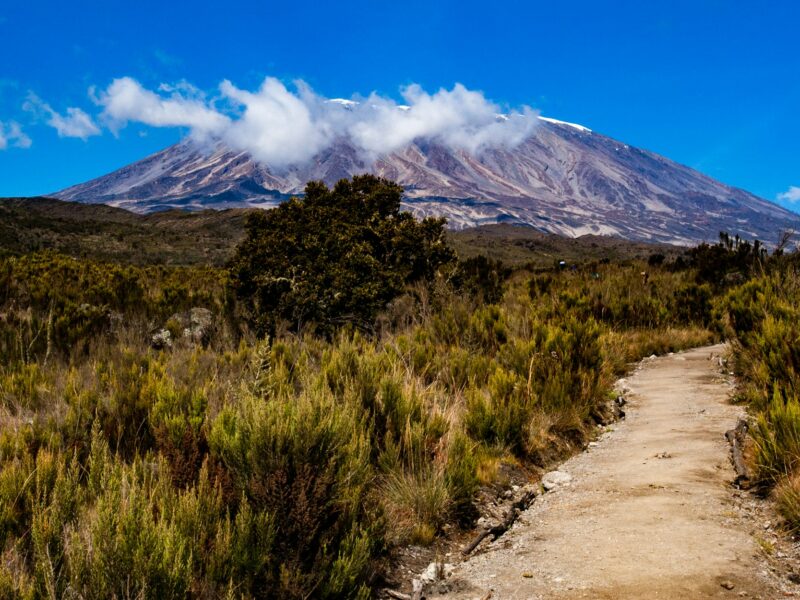
The 6 Days Rongai Route is the only established way to climb Kilimanjaro from the north, starting close to the Kenyan border and finishing on the southern Marangu trail. It is quieter than the southern routes, sits in the mountain’s drier rain shadow, and offers a gentle, steady gradient, with a night beside Mawenzi Tarn as its scenic highlight.
Because the northern slopes receive less rain, Rongai is a good option in the shoulder months and for anyone who wants fewer people on the trail. You will camp in tents throughout the ascent, then descend through the Marangu huts area to the south-east, crossing the whole mountain in six days.
At a Glance
- Duration: 6 days on the mountain; Moshi nights before and after are optional
- Route: Rongai ascent, Marangu descent
- Gates: Rongai (Nalemoru) Gate, about 1,950 m, to Marangu Gate, about 1,870 m
- Summit: Uhuru Peak at about 5,895 m, via Gilman’s Point
- Difficulty: moderate
- Best months: late December–early March and June–October, with useful shoulder-season options
- Accommodation: tents on the way up; camping near the huts on the way down
- Group size: private groups of any size, or a shared small group
Day-by-Day Itinerary
The drive from Moshi to the northern gate takes several hours, passing farmland and villages on the mountain’s eastern side.
Day 1: Nalemoru Gate → Simba Camp
After registering, you set off through pine plantations and farmland, then into a narrow strip of forest where colobus monkeys are common. The trail is gentle and the first camp sits on the edge of the moorland with views over the plains towards Kenya.
Elevation: 1,950 m → 2,600 m · Hiking time: approximately 3–4 hours · Habitat: forest edge and plantation
Day 2: Simba Camp → Second Cave → Kikelewa Camp
A steady climb through heath brings you to Second Cave at about 3,450 m for lunch, with Kibo’s snowy dome on the skyline. In the afternoon, you leave the main trail and head towards the jagged peaks of Mawenzi to reach Kikelewa Camp, set in a sheltered valley.
Elevation: 2,600 m → 3,450 m → 3,600 m · Hiking time: approximately 6–7 hours · Habitat: heath and moorland
Day 3: Kikelewa Camp → Mawenzi Tarn
A short, steep pull over grassy moorland leads to Mawenzi Tarn, a small lake cupped beneath the towering spires of Mawenzi. In the afternoon, a short acclimatisation walk higher up the ridge helps your body adjust before you return to camp.
Elevation: 3,600 m → 4,330 m · Hiking time: approximately 3–4 hours · Habitat: upper moorland and alpine zone
Day 4: Mawenzi Tarn → Kibo Hut
You cross the lunar landscape of the Saddle between Mawenzi and Kibo, a wide desert of grit and boulders. The summit cone looms larger with every step. Arrive at Kibo Hut, eat early and rest before midnight.
Elevation: 4,330 m → 4,703 m · Hiking time: approximately 4–5 hours · Habitat: alpine desert
Day 5: Kibo Hut → Uhuru Peak → Horombo Hut
From midnight, climb steep switchbacks on loose scree to Gilman’s Point (about 5,681 m), then follow the crater rim past Stella Point to Uhuru Peak. Return to Kibo Hut for a break and continue down the Marangu route to Horombo.
Elevation: 4,703 m → 5,895 m → 3,720 m · Hiking time: approximately 11–15 hours · Habitat: arctic summit zone
Day 6: Horombo Hut → Marangu Gate
Descend through heath and lush rainforest to Marangu Gate. Your summit certificate is issued here before the short drive back to Moshi.
Elevation: 3,720 m → 1,870 m · Hiking time: approximately 5–6 hours · Habitat: heath into forest
Altitude Profile
| Day | Camp | Altitude |
|---|---|---|
| 1 | Simba Camp | 2,600 m |
| 2 | Kikelewa Camp | 3,600 m |
| 3 | Mawenzi Tarn | 4,330 m |
| 4 | Kibo Hut | 4,703 m |
| 5 | Uhuru Peak, down to Horombo | 5,895 m / 3,720 m |
| 6 | Marangu Gate | 1,870 m |
Included and Not Included
Included on this climb:
- Long transfer to the northern gate
- Return transfer from Marangu Gate
- Park, camping and rescue fees
- Licensed guides and full crew
- Sleeping tents and mess tent
- Meals and safe drinking water
- Oxygen, oximeter and first-aid kit
Not part of the package:
- Flights to Kilimanjaro International Airport
- Visas and insurance
- Personal kit, including sleeping bag
- Accommodation in Moshi unless requested
- Tips for your mountain team
Is This Itinerary Right for You?
Choose six days on Rongai if you want a quieter trail, gentler slopes and a better chance of dry weather in the shoulder months. It suits steady walkers, including many climbers in their fifties and beyond; see our advice on climbing Kilimanjaro over 50. If you can spare one more day, the 7 Days Rongai Route adds an extra night on the approach. Not sure which trail suits you? Read which Kilimanjaro route is best, or learn more about the Rongai route itself.
Tips for the 6 Days Rongai Route
- The northern side is drier, but it can still be cold and windy; check our Kilimanjaro weather by month guide before you pack.
- Bring a buff or scarf for dust on the Saddle crossing.
- Make the most of the afternoon walk above Mawenzi Tarn; it is valuable acclimatisation.
- A private toilet tent can be added on request; our page on toilets and hygiene on Kilimanjaro explains what to expect.
- Expect a longer drive on day one, so pack snacks and water.
Rongai’s quieter trail is good news for porters too, and we support the welfare standards promoted by the Kilimanjaro Porters Assistance Project. For geology, glaciers and the mountain’s history, the Wikipedia entry on Mount Kilimanjaro is a useful read.
Plan Your Rongai Climb
Compare Rongai with the other routes on our Kilimanjaro climbing itineraries page, then ask us for a tailored Rongai proposal.