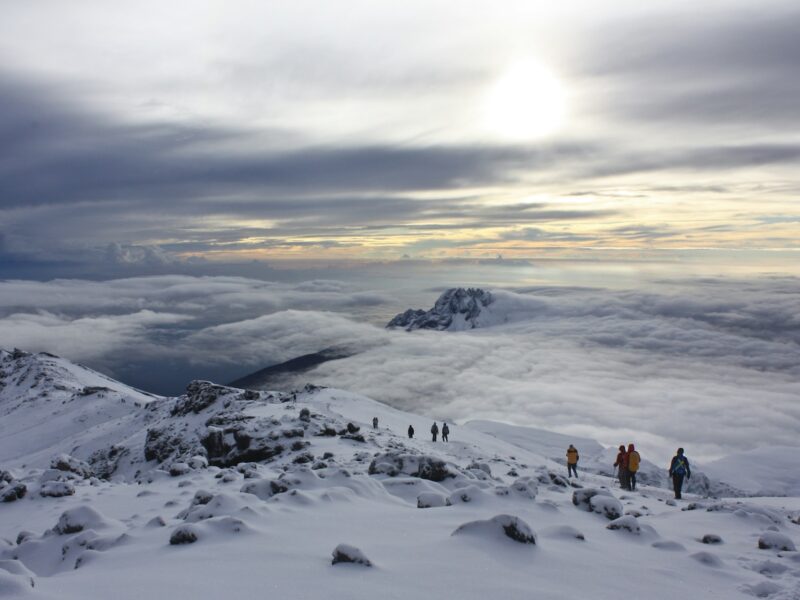
Kilimanjaro weather by month follows a simple pattern: two dry seasons, two rainy seasons, and cold at the top all year round. Understanding that rhythm helps you pick dates, choose a route and pack the right layers. Below we explain how conditions usually change through the year, with the caveat that mountain weather is never fully predictable and every season has its exceptions.
Because the mountain sits close to the equator, day length barely changes and there is no true summer or winter. What changes is moisture. Moist air from the Indian Ocean brings the long rains around April and May and the short rains around November. Between those periods the air is drier and the skies clearer, which is why most climbers aim for roughly late December to early March or June to October.
How Altitude Shapes the Weather
On any single climb you pass through several climate zones. The lower slopes are warm and humid, often misty in the afternoons. The moorland is cooler and breezy, with cold nights. The alpine desert above about 4,000 m is dry, sunny by day and frosty after dark. The summit zone around Kibo is arctic: on summit night, which usually starts around midnight, conditions are often well below freezing and wind chill makes it feel colder still. Our climate and vegetation zones guide describes each band in more detail.
The practical upshot is that you need gear for every condition, whatever month you travel. Sun protection matters as much as insulation, because ultraviolet light is intense at altitude and reflects off snow.
Kilimanjaro Weather by Month: Overview Table
| Month | Typical pattern | Climbing notes |
|---|---|---|
| January | Mostly dry, warmer days, clear mornings | Excellent; popular after New Year |
| February | Dry with occasional afternoon cloud | Excellent; a favourite month |
| March | Transition; showers increase late in the month | Good early on, quieter |
| April | Long rains; heavy cloud and wet forest | Challenging; very few climbers |
| May | Long rains continue, easing late | Wet; snow possible higher up |
| June | Drying out; cooler nights | Good; numbers rise late in the month |
| July | Dry, cool and clear | Very good; busy |
| August | Dry, clear, often the clearest views | Very good; busy |
| September | Dry and settled | Excellent; slightly quieter than August |
| October | Mostly dry; clouds build late | Good; shoulder season |
| November | Short rains, often brief showers | Fair; quiet trails |
| December | Drying from mid-month | Good; very busy at the holidays |
January and February
These are among the most reliable months. Mornings usually dawn clear, cloud may build around the forest in the afternoon and then drop away at night. Days on the lower mountain feel a little warmer than in the mid-year dry season. Snow on the summit is possible after occasional storms, which makes for striking photographs.
March to May
March is a month of change. The first half often stays settled, but showers become more frequent as the long rains approach. April and May are the wettest months: the forest is muddy, the moorland is often in cloud and higher camps can receive snow. The northern side tends to be a little drier, so climbers in this period sometimes prefer the Rongai approach. The upside of the wet months is solitude: camps are quiet, the forest is at its greenest and the waterfalls on the southern slopes run strongly. If you choose this window, pack two complete sets of dry clothing in waterproof bags, line your rucksack, and expect some days when the summit stays hidden behind cloud until evening.
June to October
The long dry season begins in June. Nights become colder, particularly in July and August, but the skies are frequently cloudless and the views of Mawenzi and the plains are superb. September and early October keep the dry weather with fewer people. By late October, clouds start to gather again in the afternoons.
November and December
November brings the short rains, usually afternoon or evening showers that clear overnight. Trails are quieter, and if you can accept the odd wet afternoon it can be a rewarding month. By mid-December the weather is generally improving, and the holiday period around Christmas and New Year is one of the busiest of the year.
Packing for the Weather
Plan to layer from the start. A breathable base layer, insulating mid-layers, a warm down jacket, a waterproof shell and good gloves cover almost every situation. Waterproofs are essential in the rainy months and still sensible in the dry ones. See our full Kilimanjaro gear list, and if you would rather hire bulky items, read about gear rental in Moshi.
Snow, Glaciers and Summit Night
The summit zone can be dusted with snow in any month, but it is most likely after the rains. The ice fields near the crater rim are retreating, as described in our Kilimanjaro glaciers article. Whatever the month, prepare thoroughly for the cold, dark hours before sunrise with our summit night guide.
Choosing Your Dates
Weather is only one factor. Holidays, moon phases, flight availability and your training timeline all matter. Our guide to the best time to climb Kilimanjaro weighs those factors alongside the seasons. For more on the mountain’s geography and volcanic summit, see the Kibo article and the broader Mount Kilimanjaro entry on Wikipedia. You will find more practical reading in the Kilimanjaro climbing guide.
Not sure which month suits you? Send us your preferred window and we will suggest the best route for those conditions.