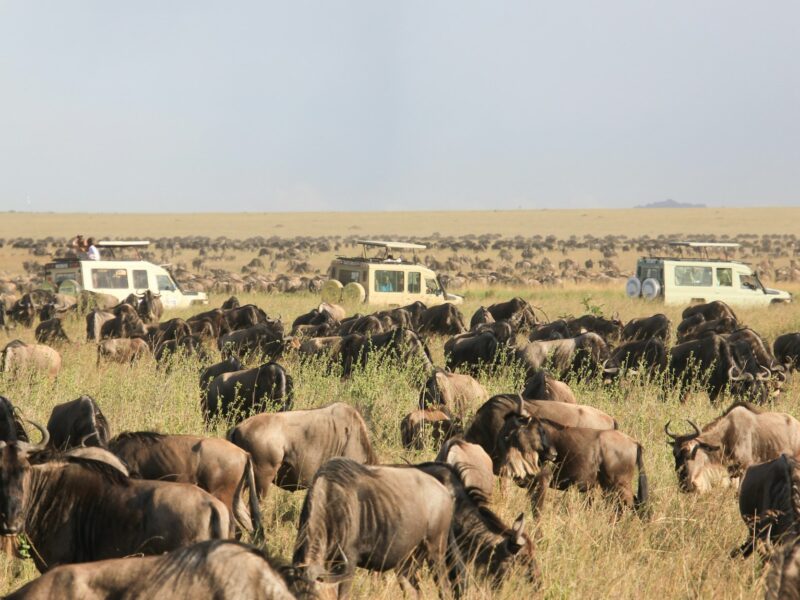
December to March: southern plains
The herds graze the short grass around Ndutu and the southern Serengeti. Calving usually peaks around February.
April to June: central and western Serengeti
As the plains dry, the herds move north-west through the central Serengeti and into the Western Corridor, crossing the Grumeti River.
July to October: northern Serengeti
The herds reach the north, crossing the Mara River back and forth. This is the season of the famous river crossings.
November: heading south
With the short rains, the herds move back south through the eastern Serengeti towards the calving grounds.
Plan with local experts
Our planners in Arusha can help with every detail of your trip. Request a free quote or browse our safari packages.
The migration in numbers
Estimates usually put the wildebeest at well over a million animals, accompanied by hundreds of thousands of zebras and gazelles. They follow the rains in a roughly clockwise loop through the Serengeti and Kenya’s Maasai Mara, covering many hundreds of kilometres a year.
Detailed calendar
| Month | Typical location | Highlights |
|---|---|---|
| January | Southern plains, Ndutu | Herds settle, calving begins |
| February | Ndutu and southern Serengeti | Peak calving, predator action |
| March | South and moving west | Calves growing, herds massing |
| April | Central and western Serengeti | Long rains, herds on the move |
| May | Western Corridor | Rutting season begins |
| June | Western Corridor, Grumeti River | Grumeti crossings, crocodiles |
| July | Northern Serengeti | First Mara River crossings |
| August | Northern Serengeti and Maasai Mara | Peak Mara crossings |
| September | Northern Serengeti | Crossings back and forth |
| October | Northern Serengeti | Herds begin to turn south |
| November | Eastern and central Serengeti | Short rains, herds heading south |
| December | Southern Serengeti | Herds arrive on the short grass |
How we place you in the right spot
Our guides share daily sightings, and we use mobile tented camps that relocate with the herds. Before you travel we confirm where the herds are and adjust the itinerary.
Migration safaris
Why the herds move
The migration follows rainfall and fresh grass. The southern plains offer mineral-rich grazing during the rains, while the north and west hold water and grass during the dry season.
What you see in each phase
The calendar above shows where the herds usually are. Just as important is what they are doing, because each phase of the migration offers a different kind of safari.
| Phase | Typical months | What you see |
|---|---|---|
| Calving | Late January to March | Hundreds of thousands of calves born in a few weeks, intense predator action |
| Long rains movement | April to May | Long columns of wildebeest, fewer vehicles, green landscapes |
| Rut and Grumeti | May to July | Bulls fighting, herds crossing the Grumeti River |
| Mara crossings | July to October | Dramatic river crossings, crocodiles, big concentrations |
| Return south | November to December | Herds streaming south through the eastern and central Serengeti |
Where to stay in each season
Choosing the right base matters more than almost anything else on a migration safari.
- December to March: camps around Ndutu and the southern plains, which spans the Serengeti and the Ngorongoro Conservation Area
- April to June: the central Serengeti around Seronera, and the Western Corridor as the herds move west
- July to October: the far north around Kogatende and the Lamai Triangle near the Mara River
- November: the eastern and central Serengeti as herds pass through on their way south
Seasonal mobile camps relocate during the year to stay close to the herds, while permanent lodges in the central Serengeti offer good year-round wildlife even when the migration is elsewhere.
Why timings vary from year to year
The migration is driven by rain, not by the calendar. If the short rains arrive late, the herds may linger in the north; if the southern plains dry early, they may leave the calving grounds sooner. The herds also split into separate groups, so part of the migration can be in one area while another part is many kilometres away.
That is why we recommend building in a little flexibility, staying three nights or more in the area where the herds are expected, and trusting your guide’s daily updates. Our Great Migration 2027 calendar looks ahead to next year.
Which month suits you best
- First-time visitors who want variety: February for calving and predators
- Photographers seeking drama: August and September for Mara crossings
- Travellers wanting fewer crowds: the green months of April, May and November
- Families: the school holidays in July and August combine crossings with good weather
For crossings specifically, read our Mara River crossing tips from our guides, or see the 7 days Mara River crossing safari and 5 days private Ndutu calving safari.
Following the Migration on a Private Safari
Because the herds move with the rains, their exact position changes from year to year. A Tanzania private safari gives your guide the freedom to drive further, stay longer at a crossing point or change plans when the wildebeest move.
Month by month, privately
- December to March: on the southern plains around Ndutu, where calving usually peaks around February
- April to June: through the central Serengeti and into the Western Corridor, crossing the Grumeti River
- July to October: in the northern Serengeti, where waiting patiently by the Mara River is far easier without a group schedule
- November: heading south through the eastern Serengeti
We choose camps close to where the herds are likely to be, and we can include light-aircraft flights to save time. See migration itineraries among our private luxury safaris.
To time your trip, plan your private safari with our team.
Related reading from our Safari Journal
Further reading
Learn more from independent, authoritative sources: