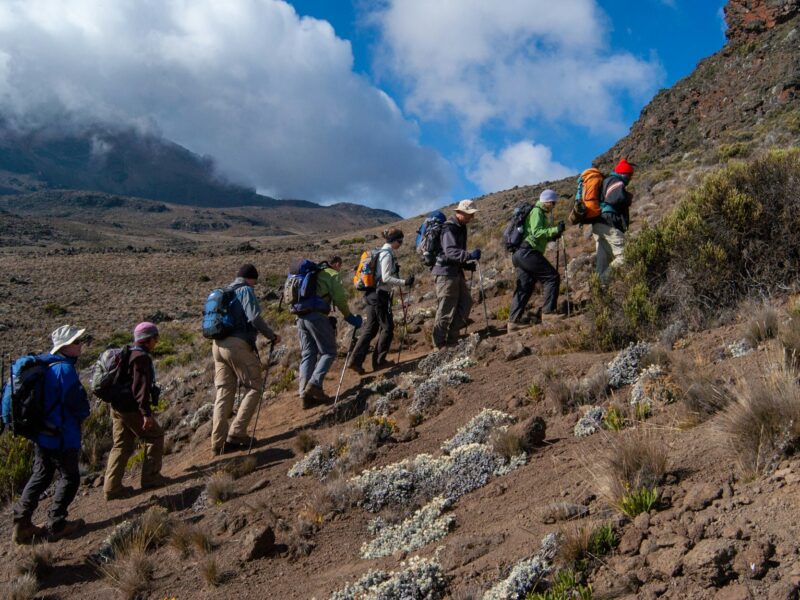
Route at a glance
- Duration: 3–4 days
- Difficulty: Moderate to challenging
- Summit: Socialist Peak, 4,566 m
Highlights
- Summit at 4,566 m
- Wildlife on the lower slopes
- Views of Kilimanjaro
- Great acclimatisation
Day-by-day itinerary
Day 1: Momella Gate (1,500 m) to Miriakamba Hut (2,514 m)
Walk with an armed ranger through Arusha National Park's grassland and forest, often passing giraffes and buffalo, to Miriakamba Hut.
Overnight: Miriakamba Hut, 2,514 m · Hiking: 4–5 hours
Day 2: Miriakamba Hut to Saddle Hut (3,570 m)
Steep climb through forest to Saddle Hut; afternoon side trip to Little Meru (3,820 m) for acclimatisation.
Overnight: Saddle Hut, 3,570 m · Hiking: 3–4 hours
Day 3: Summit Socialist Peak (4,566 m), descend to Miriakamba
Early start along the crater rim ridge to the summit at sunrise, with Kilimanjaro on the horizon. Descend to Miriakamba Hut.
Overnight: Miriakamba Hut, 2,514 m · Hiking: 10–12 hours
Day 4: Miriakamba Hut to Momella Gate
Descend through the park and transfer to Arusha.
Overnight: Hotel in Arusha · Hiking: 2–3 hours
Altitude and daily hiking summary
| Day | Stage | Overnight / altitude | Hiking time |
|---|---|---|---|
| Day 1 | Miriakamba Hut (2,514 m) | Miriakamba Hut, 2,514 m | 4–5 hours |
| Day 2 | Saddle Hut (3,570 m) | Saddle Hut, 3,570 m | 3–4 hours |
| Day 3 | Miriakamba | Miriakamba Hut, 2,514 m | 10–12 hours |
| Day 4 | Momella Gate | Hotel in Arusha | 2–3 hours |
What is included on every climb
- Certified, first-aid trained lead guide and assistant guides
- Fairly paid, properly equipped porters and a mountain cook
- All park, camping/hut and rescue fees
- Quality four-season tents, sleeping mats, mess tent with table and chairs
- Three hot meals a day plus snacks; treated drinking water
- Daily health checks with pulse oximeter; emergency oxygen carried
- Hotel nights in Moshi before and after the climb (bed and breakfast)
- Airport transfers and transport to and from the gates
Not included
- International flights and visa
- Travel insurance covering trekking to 6,000 m
- Tips for the mountain crew (customary)
- Personal climbing gear (rental available)
Booking and availability
We run private climbs on any date and group departures throughout the climbing seasons. Every climb includes certified guides, a fair-paid porter team, quality tents, nutritious meals and park fees. Emergency oxygen and a pulse oximeter are carried for daily health checks.
Compare all routes on our Kilimanjaro climbing page or book a private climb.
Acclimatisation and safety
Altitude is the main challenge on Kilimanjaro. Walking slowly (‘pole pole’ in Swahili), drinking plenty of water and choosing a route with enough days are the best ways to acclimatise. Your guides check your oxygen saturation and pulse every day and will descend with you if needed.
What to pack
- Warm sleeping bag rated to around -10 °C
- Layered clothing, down jacket, waterproofs
- Broken-in hiking boots
- Head torch, trekking poles, water bottles
- Sunscreen and sunglasses
Rental gear is available in Moshi.
Meru and Kilimanjaro compared
Mount Meru is often climbed on its own, but it is also the best warm-up for Kilimanjaro. The table below shows how the two differ.
| Mount Meru | Mount Kilimanjaro | |
|---|---|---|
| Summit height | 4,566 m (Socialist Peak) | 5,895 m (Uhuru Peak) |
| Typical duration | 3–4 days | 5–9 days depending on route |
| Accommodation | Mountain huts with bunk beds | Tents on most routes, huts on Marangu |
| Wildlife | Buffalo, giraffe and colobus on the lower slopes | Limited wildlife |
| Walking escort | Armed park ranger | Guide team only |
| Busy-ness | Quiet | Busier, especially on popular routes |
Our article on Mount Meru vs Kilimanjaro goes into more detail, and the Mount Kilimanjaro page covers the higher mountain.
Life in the huts
Unlike most Kilimanjaro routes, Meru uses permanent huts at Miriakamba and Saddle. You sleep in shared bunk rooms on mattresses, and meals are cooked by your mountain crew. Huts are basic, so bring a warm sleeping bag, earplugs and a head torch. On busy dates you may share rooms with climbers from other groups.
The summit ridge
Summit night is the highlight and the toughest part of the climb. From Saddle Hut you set off in the dark and follow a narrow ridge along the rim of Meru’s collapsed crater. Some sections are exposed and rocky, with steep drops to one side, and in places you scramble using your hands. As the sun rises, you look down into the crater towards the ash cone and across to Kilimanjaro on the horizon. The ridge suits walkers who are comfortable with heights; your guide sets a careful pace.
Using Meru to acclimatise for Kilimanjaro
Climbing Meru a few days before Kilimanjaro lets your body adapt to altitude, which can improve your chances on the higher mountain. A typical plan is to descend from Meru, rest for a day in Arusha or Moshi, then start Kilimanjaro. Our private Kilimanjaro climb page explains how we combine the two.
Best months to climb
The drier months from June to October and from late December to February usually bring the clearest views and the best conditions on the ridge. The long rains from March to May make the forest trails muddy and summit views less reliable. Mornings near the summit are cold all year, so pack for temperatures below freezing.
Read our guide to altitude sickness before you go; the advice applies to Meru too, and the climb starts in Arusha National Park.
Mount Meru as a Private Trek
Meru sits inside Arusha National Park, so the walk from Momella Gate begins in grassland and forest, often passing giraffes and buffalo, with an armed ranger alongside. On a private climb your guide and crew are dedicated to your party, and your days between Miriakamba Hut and Saddle Hut are planned around you.
How it fits a wider trip
- A three or four day climb that gives great acclimatisation before Kilimanjaro
- An afternoon side trip to Little Meru from Saddle Hut
- Easy to join to a Tanzania private safari, as you start inside a national park
- Views of Kilimanjaro on clear days
Meru is moderate to challenging, so it suits active travellers who want a summit without the length of a Kilimanjaro climb. We combine it with game drives or with a longer climb; our Tanzania safari packages show the options.
To arrange your trek, plan your private safari and climb with us.
Related reading from our Safari Journal
- Mount Meru vs Kilimanjaro: Which Should You Climb?
- Kilimanjaro Training Plan: How to Prepare in 12 Weeks
- Altitude Sickness on Kilimanjaro: How to Prevent It
Further reading
Learn more from independent, authoritative sources: