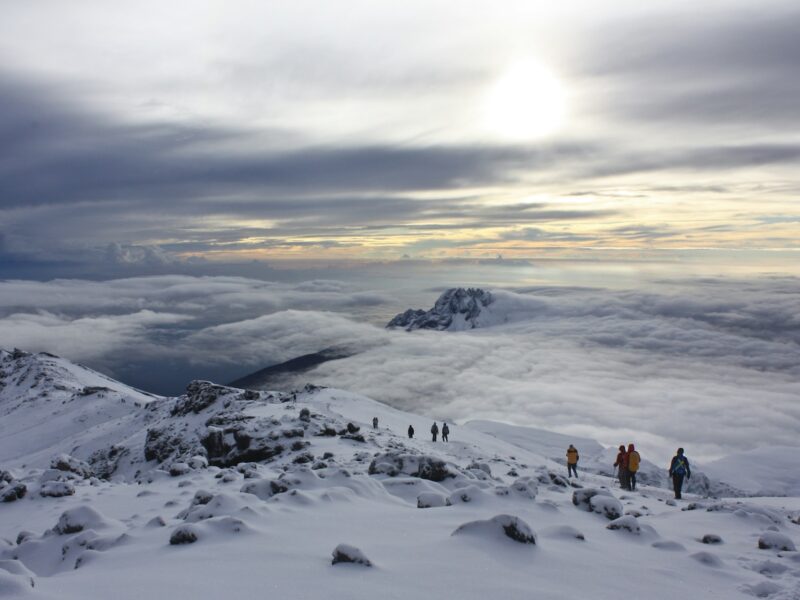
The 9 days northern circuit route is the longest and quietest way to climb Kilimanjaro, circling almost the whole of Kibo before you reach the summit at Uhuru Peak (about 5,895 m). Because you spend so many nights gaining height gradually, it gives your body more time to adjust than any other standard itinerary.
Climbs with more days generally give a better chance of reaching the summit, and this one has the most days of all. You trade speed for space: fewer people on the trail, wide views towards Kenya, and a summit approach from the north-east that avoids the busy Barafu camp on the way up. Read our overview of the Northern Circuit route, or compare it with every other option on our Kilimanjaro climbing itineraries hub.
At a Glance
- Duration: 9 days on the mountain (arrival and departure days in Moshi or Arusha optional)
- Route: Northern Circuit, starting as Lemosho
- Start gate: Londorossi Gate, about 2,250 m
- End gate: Mweka Gate, about 1,640 m
- Summit: Uhuru Peak, about 5,895 m, via Gilman’s Point and Stella Point
- Difficulty: moderate to challenging; long but well paced
- Best months: roughly late December to early March, and June to October
- Accommodation: mountain tents throughout
- Group size options: private climb or a shared small-group departure
Day-by-Day Itinerary
Day 1: Londorossi Gate → Mti Mkubwa (Big Tree) Camp
After a scenic drive from Moshi or Arusha to the western side of the mountain, you register at Londorossi Gate while your crew weighs and packs loads. The trail climbs gently through mossy forest. Camp sits among huge old trees.
Elevation: 2,250 m → 2,750 m · Hiking time: about 3–4 hours · Habitat: montane rainforest
Day 2: Mti Mkubwa → Shira 1 Camp
The forest thins into giant heather and then open moorland as you crest the rim of the ancient Shira volcano. Expect your first full view of Kibo’s glaciers across the plateau. Pace is deliberately slow, and your guide will begin daily health checks this evening.
Elevation: 2,750 m → 3,610 m · Hiking time: about 5–6 hours · Habitat: heath and moorland
Day 3: Shira 1 Camp → Shira 2 Camp
A shorter, easy-going day across the flat Shira Plateau, the third and oldest of Kilimanjaro’s volcanic cones. The modest gain helps your body settle before the high traverse begins.
Elevation: 3,610 m → 3,850 m · Hiking time: about 4–5 hours · Habitat: moorland
Day 4: Shira 2 Camp → Lava Tower → Moir Hut
You climb east to the Lava Tower at about 4,630 m for lunch, then turn north and descend to Moir Hut. This is the classic “climb high, sleep low” day and a key moment for acclimatisation. From here the crowds on the southern routes are left behind.
Elevation: 3,850 m → 4,630 m → 4,200 m · Hiking time: about 6–7 hours · Habitat: alpine desert
Day 5: Moir Hut → Buffalo Camp
The trail rises over a ridge and then contours around the northern slopes of Kibo, with long views north across the plains towards Kenya and Amboseli.
Elevation: 4,200 m → 4,020 m · Hiking time: about 5–7 hours · Habitat: alpine desert and high moorland
Day 6: Buffalo Camp → Third Cave Camp
Continuing eastward, you cross a series of valleys and ridges below Kibo’s northern ice fields. Third Cave sits on the saddle side of the mountain.
Elevation: 4,020 m → 3,870 m · Hiking time: about 5–6 hours · Habitat: alpine desert
Day 7: Third Cave Camp → School Hut
A steady climb up towards the Saddle between Kibo and Mawenzi brings you to School Hut, your high camp. Arrive early, eat well, rest and prepare kit for the night ahead.
Elevation: 3,870 m → 4,750 m · Hiking time: about 4–5 hours · Habitat: alpine desert
Day 8: School Hut → Uhuru Peak → Mweka Camp
Summit night usually starts around midnight. You zig-zag up loose scree to Gilman’s Point on the crater rim, then follow the rim past Stella Point to Uhuru Peak, the highest point in Africa. After photographs you descend via Stella Point and Barafu Camp to Mweka Camp for a well-earned sleep.
Elevation: 4,750 m → 5,895 m → 3,100 m · Hiking time: about 12–15 hours in total · Habitat: arctic summit zone to heath
Day 9: Mweka Camp → Mweka Gate
A final walk down through lush forest to Mweka Gate, where summit certificates are issued, before the transfer to your hotel.
Elevation: 3,100 m → 1,640 m · Hiking time: about 3–4 hours · Habitat: montane rainforest
Altitude Profile
| Day | Camp | Altitude |
|---|---|---|
| 1 | Mti Mkubwa (Big Tree) Camp | 2,750 m |
| 2 | Shira 1 Camp | 3,610 m |
| 3 | Shira 2 Camp | 3,850 m |
| 4 | Moir Hut | 4,200 m |
| 5 | Buffalo Camp | 4,020 m |
| 6 | Third Cave Camp | 3,870 m |
| 7 | School Hut | 4,750 m |
| 8 | Mweka Camp (after Uhuru 5,895 m) | 3,100 m |
| 9 | Mweka Gate | 1,640 m |
Included and Not Included
Included:
- Licensed mountain guide and assistant guides
- Cook, porters and full camp crew
- Park fees paid to the authorities
- Sleeping tents, mess tent and camp furniture
- All meals and treated drinking water on the trail
- Transfers between hotel and gates
- Pulse oximeter checks twice daily
- Emergency oxygen and first-aid kit
Not included:
- International and domestic flights
- Visa and travel insurance
- Personal clothing and sleeping bag (rental available)
- Hotel nights before and after the climb, unless booked with us
- Tips for guides, cooks and porters
Is This Itinerary Right for You?
This itinerary suits climbers who want the most gradual ascent available, value solitude and do not mind longer days on the trail. It also suits nervous first-timers. If your time is limited, the 8 days Lemosho route offers similar western scenery in one day less.
9 Days Northern Circuit Route Tips
- Treat the long traverse as training for summit night: keep a slow, even rhythm and drink regularly.
- Read our guide on how to acclimatise on Kilimanjaro before you go.
- Learn the symptoms of altitude sickness on Kilimanjaro and tell your guide early if you feel unwell.
- Check our Kilimanjaro gear list, because nine nights in tents reward a warm sleeping bag.
Further reading: the Kibo volcano you circle on this route, and current park regulations from Tanzania National Parks (TANAPA).
Plan Your Northern Circuit Climb
Tell us your preferred dates, group size and fitness level and we will tailor this itinerary. Start with our trip planning form and a specialist will reply with a detailed proposal.